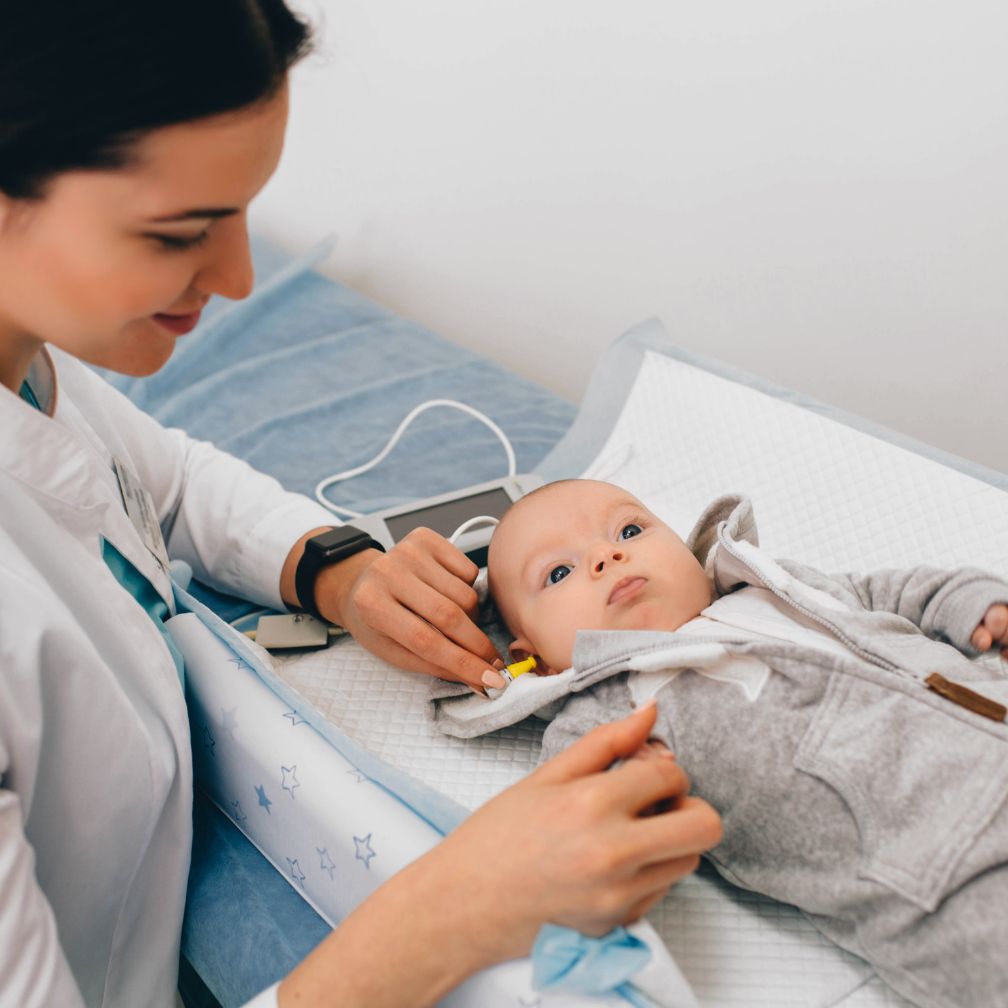
For parents bringing home a newborn, realizing their child suffers from hearing impairment can trigger overwhelming feelings of anxiety. The reassuring truth is that by applying prompt testing and therapeutic help, young children with hearing deficits can truly succeed. Remarkably, such young children can gain verbal abilities, social skills, and solid bonds within their surroundings, cultivating a deeply rich existence!
Relying on modern hearing aids and advanced cochlear implants yields two reliable clinical methods for supporting babies with hearing impairment. In the section below, we examine their functional mechanisms and clarify how to select the perfect fit for your infant.
Analyzing Infant Auditory Deficits
Hearing loss in infants can be caused by a range of factors, including:
- Underlying genetic predispositions (even in the absence of verified familial lineage)
- Primary maternal congenital infections such as cytomegalovirus (CMV) or rubella
- Critical labor complications, featuring perinatal hypoxia or premature delivery
- Particular pharmaceutical treatments utilized inside neonatal intensive units
What serves as the chief goal for families? Swift clinical screening. Consequently, newborns within United States birth units undergo auditory screening before returning home. Pediatric hearing experts strictly observe the established “1-3-6” care guideline:
- First-stage screening administered prior to 1 month
- Confirmed hearing diagnosis confirmed by 3 months of age
- Dedicated treatment (utilizing medical units or targeted speech therapy) started prior to 6 months post-birth
Executing these procedural steps delivers to infants their ideal path toward flourishing speech, language mastery, and neurological health. Should you seek direction regarding these auditory screens, your pediatrician will be happy to help!
Understanding Amplification Devices for Infants
In cases where babies exhibit mild to severe hearing challenges, custom hearing aids usually act as the frontline remedy. These compact, external instruments boost ambient audio signals, helping babies process spoken dialogue and everyday sounds more distinctly.
Infant-adapted hearing aids function as:
- Highly safe for fitting on young babies merely a few weeks old
- Crafted featuring soft, comfortable ear molds that change as the baby grows
- Built with child-resistant battery compartments and specialized pediatric safety components
- Individually configured by a pediatric hearing professional to target your infant’s specific hearing levels
As your baby grows, their hearing devices must undergo periodic adjustments to guarantee proper physical fit and maximum performance.
Cochlear Implant Options for Newborns
In cases where a baby suffers from profound sensorineural hearing deficits that fails to respond adequately to conventional hearing aids, specialists routinely suggest a cochlear implant. In contrast to traditional hearing devices, cochlear implants:
- Must be placed via a specialized surgical procedure by an experienced otolaryngologist
- Safely bypass non-functional structural regions in the cochlea
- Convert sound waves into focused electrical signals that actuate the nerve of hearing
Integrated cochlear implant systems serve as:
- Officially FDA-approved for application in young infants starting at 9 to 12 months of age
- Remarkably effective when combined with specialized rehabilitation and active household backing
- Prescribed solely following a comprehensive diagnostic assessment by a pediatric audiologist and ear, nose, and throat doctor
This process includes radiological imaging, objective hearing assessments, and in-depth discussions surrounding achievable long-term goals.
Hearing Aids or Cochlear Implants: Distinguishing Features
- Mild to severe levels of impairment utilize Hearing Aids; Severe to profound levels of loss demand Cochlear Implants
- Non-Invasive wearable design: Hearing Aids; Invasive surgical placement: Cochlear Implants
- Traditional acoustic amplification: Hearing Aids; Converts Sound Electrical Signals: Cochlear Implants
- Treatment starts in newborn infancy: Hearing Aids; Access starts at 9-12 months: Cochlear Implants
Hearing Aids vs. Cochlear Implants: Final Thoughts
If your baby has been diagnosed with hearing loss, remember that proven treatment choices and plenty of support. Under the care of specialized pediatric hearing doctors, many children go on to develop speech and language milestones fully matching their playmates.
Whether your child is a candidate for hearing aids or cochlear implants, early action unlocks lifelong developmental success.
Are you looking for clarity regarding your infant’s hearing development? Call our clinic today for a complete diagnostic review and tailor-made care roadmap.